Human Design Solar Plexus in Business
What the Solar Plexus Center Actually Is
You have made a business decision at 11pm during a wave of anxiety that felt like clarity in the moment, and looked nothing like clarity by morning.
You have also sat on a decision for weeks, waiting to feel calm enough to act, while the actual window closed without you.
That is not indecision, and it is not you being too emotional for business. That is your Solar Plexus Center, doing exactly what it does. The real question is not whether you feel your business. It is whether you have learned to tell the difference between a wave and a verdict.
The Solar Plexus Center is the center of emotions, emotional waves, and emotional truth over time. About half of us carry this center defined, generating emotional waves that ripple into teams, client relationships, and launches whether we name them out loud or not. The other half has an open Solar Plexus, and spends a lifetime learning to sail waves that were never fully theirs to begin with.
Emotions are not a problem here. They are energy in motion: real, moving, and very much your truth in the moment. For a business owner, that distinction is everything. A feeling that is true right now, or even true for you, is not the same thing as a fact about your business.
Defined Solar Plexus: Your Weather Shapes the Room
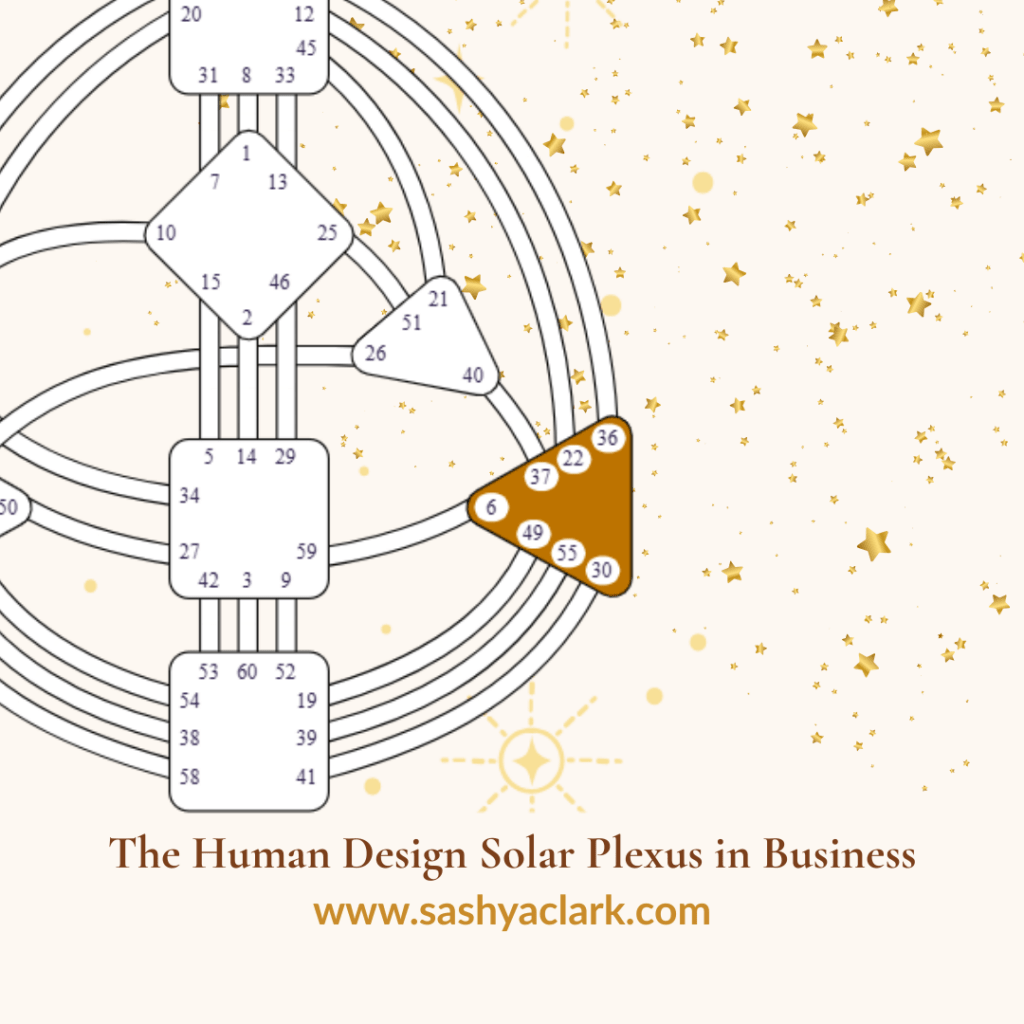
If your Solar Plexus is defined, you generate a consistent emotional climate, and everyone near your business feels it: your team, your clients, the tone of your launches. This is not a flaw to manage. It is a real signal, once you let it move through before you act on it.
The trap for a defined Solar Plexus is treating today’s wave as final: sending the email at the peak of frustration, pricing an offer from a moment of doubt, deciding a launch failed before the numbers are even in. Your waves are real. They are just not finished until they finish.
There is an old truth hiding in that patience too. Before mirrors existed, the only reflection anyone had was their own face in still water, and the calmer the water, the clearer the image.
A defined Solar Plexus works the same way. Wait for the water to settle, and you see yourself and your business clearly, instead of the distortion the wave was throwing up a moment ago.
Undefined Solar Plexus: You Feel the Whole Room
If your Solar Plexus is open, you do not generate a consistent emotional signal of your own. You pick up and amplify the emotional energy around you: a tense client call lingers, a teammate’s stress becomes your stress, a launch that should feel exciting suddenly feels heavy for reasons that are not fully yours.
I carry a completely open Solar Plexus myself. No gates, no definition there at all. For years this was one of my biggest sources of conditioning, and later, one of my best business teachers, especially during twelve years working in a counseling role, where I learned to hold a room’s emotional intensity without absorbing it as my own.
The work for an open Solar Plexus in business is not to stop feeling the room. It is to wait for the room to clear before making a decision that was never fully yours to make in the first place.
The Emotional Wave Patterns: What They Are Telling You
Emotions are energy in motion. They move in waves, and a lot of people spend real effort trying to prevent the low points instead of just moving through them. That resistance is exhausting, and it works no better in a business than anywhere else.
There are four main wave patterns, each with its own rhythm and its own way of showing up in a business.
The Source Wave: Channel 6-59
This wave behaves like the tide: slowly swelling, slowly receding. It governs closeness, chemistry, and the friction that comes with real intimacy, whether that is a partnership, a long-term client relationship, or how close you let people get to your work.
Track your own baseline here. A simple mood or energy log kept for a few weeks will show you what your normal tide looks like, so you can spot the disturbance the moment one comes.
The Tribal Waves: Channel 19-49 and Channel 37-40
These waves build slowly and then release: a discharge of emotion after pressure has been gathering under the surface. Channel 19-49 connects Root (Gate 19) to Solar Plexus (Gate 49): sensitivity to what the group needs, and a readiness to walk away from an agreement once it stops feeling aligned. Channel 37-40 connects Solar Plexus (Gate 37) to Heart (Gate 40): the emotional agreements that hold a team or a client community together.
The useful move here is being proactive with conflict. Release the pressure before it discharges on its own, by having a real mentor, mastermind, or business partner you can be honest with along the way.
The Individual Waves: Channel 22-12 and Channel 39-55
These waves shift fast, and they are deeply personal. Channel 22-12 connects Solar Plexus emotion (Gate 22) to Throat expression (Gate 12): a need to talk a feeling through out loud, in real time, before it can settle. Channel 39-55 connects Root (Gate 39) to Solar Plexus (Gate 55): a pull toward feeling truly alive, sometimes with an undercurrent of melancholy underneath it.
This wave responds to what you let into your ears. Curate the sound around you between client calls: the right music, or the right silence, can move a feeling instead of leaving you stuck in it. And if the feeling is still stuck after that: dance it out if you have to!
The Collective Waves: Channel 41-30 and Channel 36-35
These waves build steadily, then spike down or crash, often tied to expectations that never got named out loud. They can sit as hidden as the ocean floor, until they reach land, and then there is no missing them.
Channel 41-30 connects Root (Gate 41) to Solar Plexus (Gate 30): the hunger for a new experience, and the letdown when reality does not match the fantasy. Channel 36-35 connects Solar Plexus (Gate 36) to Throat (Gate 35): the wave of crisis and change, learned through direct experience rather than a plan.
Plan your actions here, not your outcomes. You can control the launch you run. You cannot control which wave shows up in week two, so build something you can execute regardless of how that week feels.
The real wisdom is building buffer into your schedule for both the highs and the lows, so neither one catches your business off guard.
Across all four patterns, the same truth holds: emotions will pass, and they are not facts. If you carry a defined Solar Plexus, there is no truth available to you in the moment itself. Clarity comes over time, the same way fighting a tide never once stopped it from coming in.
The move is to wait, sleep on it, and stay patient with yourself until you feel closer to neutral. That is when real clarity arrives, not before.
Emotions are neutral biofeedback: information about your attitudes, your beliefs, and your overall state, not a verdict on your business.
Picture a triangle: your thoughts, your beliefs, and your behavior at each point, all three connected by a rope, the way you would play tug of war, except this rope has no beginning and no end. Pull it toward one side and you land in the lower end of the emotional spectrum: anger, resentment, fear, shame. Pull toward the other side and you land in the higher end: love, acceptance, unconditional positive regard, patience.
Tug the rope anywhere near your beliefs, and the other two points move too. That means you have more influence over the wave than it feels like in the moment. Sometimes changing how you feel is as simple as a big glass of water and a long soak in the bath.
The point is to keep the wave moving: not getting stuck in one feeling long enough to let it define you or your business.
About half of us carry a defined Solar Plexus, with at least one of these channels active.
Learning to ride it well takes real love and acceptance of yourself, especially when the world keeps pressuring you to decide fast. Waiting through the wave will serve your business better than any decision made inside it.
Being the Shore, Not the Wave
When a client, a teammate, or your own nervous system is caught in a big wave, the job is not to drown in it alongside them. It is to be the shore: steady, present, and non-reactive, letting the wave crash, recede, and move without you needing to fix it in real time.
That steadiness teaches more about how you lead a business than any strategy call ever could.
What This Means for Making Business Decisions
The emotions of your Solar Plexus wave are important data points. But they are not the only data points to consider in your business.
Say you are trending on Pinterest right now: real clicks, real traffic, a post that is clearly taking off. And you are also picking up a low feeling about the whole Pinterest strategy. That low feeling does not mean Pinterest stopped working. It might just mean you need a break from it. Two data points, both true, pointing to two different next moves.
The mistake is letting the emotional wave become the only data point you are listening to. Track it alongside what your business is doing: revenue, conversion, what is landing and what is not. Getting into the weeds of KPIs deserves its own post, but the short version is this: check the feeling, and check the numbers, and let both inform the next move instead of letting either one drown out the other.
There is a second layer here too: your emotional baseline is not fixed. It is conditioned by your own beliefs and thinking.
A regular gratitude practice, or any consistent practice that keeps you oriented toward a higher-vibration state, tends to lift where your waves sit most days. That does not erase the wave. It just means you get to influence where neutral lives for you.
Track your waves the same way you would track any other business metric: the highs, the lows, and the neutral days too, not just the crisis moments. One of my former clients tracks hers alongside the moon cycles, and it gave her a precise feel for her own normal. That is what makes a real disturbance visible the moment it shows up, instead of three weeks later.
Human Design Gates of the Solar Plexus Center
Gate 6: Conflict carries the friction that comes before real intimacy or a real deal. In business, this shows up as the tension before a client says yes, or the friction a team has to move through before it trusts itself. The gift is not avoiding the friction. It is using it as the doorway to something more honest.
Think of Gate 6 like a jack under a car: notch by notch, the pressure rises, until it reaches the point where it has to discharge. The wise move is meeting the friction early, before the ratchet climbs past annoyed and into angry. Track your own pattern here. Notice where your discharge point tends to sit, then ask yourself: what would it look like to address this at a 2 or a 3, instead of waiting until it is a 6 or a 7?
Gate 22: Grace carries emotional openness and a sense for when the timing is right to share something, and when it is not yet ripe. In business, this shows up as charisma that cannot be forced: it either has good timing, or it reads as trying too hard.
Gate 30: Desire carries the raw feeling-hunger for experience and for more. In business, this is the fire behind a new offer idea. Left unmanaged, it can also chase the next shiny idea before the current one is finished.
Gate 36: Crisis carries the wave that arrives through unexpected change: an ending nobody scheduled, an opening nobody planned for. The full breakdown of this gate, including how it shapes client sensitivity and business decisions, lives in its own post.
Gate 37: Friendship carries community, family, and the emotional agreements that hold a team or a client relationship together. In business, this is the handshake behind the contract: the felt sense of being on the same side.
Gate 49: Principles carries a sharp sensitivity to fairness, and a readiness to walk away from an agreement the moment it stops feeling aligned. In business, this is the gate that ends a contract that is not working before the numbers even confirm it.
Gate 55: Spirit carries mood, and the pull toward feeling truly alive rather than merely comfortable. In business, this can look like a launch that succeeds or fails based on whether it felt spirited, regardless of the plan behind it.
What This Means for Your Business
Your Solar Plexus Center is not a personality quirk, and it is not a liability either. It is a navigational system with one specific rule: let the wave pass, then decide.
The client relationships that keep draining you, the launches that never quite land, the pricing you keep changing mid-cycle: your Solar Plexus has probably been signaling all of it in real time. The work is building a business with enough structure around you that you do not have to burn it all down the moment the wave arrives.
Want to Know How to Start Aligning Your Business with Your Specific Design?
Your emotional wave is an important part of your Strategy and Authority, and it is only one piece of the bigger picture written in your chart.
The Three Keys to Building a Business That Feels Like You is where I would start. It walks you through three of the most important pieces of your chart, in plain language, for free.
And if you want to keep exploring, come join me here and I will keep delivering this straight to your inbox.
(((HUGS))) — Sashya
About Sashya Clark

Sashya Clark is the founder of CaTellyst Coaching, the author of the Human Design and Gene Keys Gates Library, and the creator of the Business by Design Strategy Session ℠, a proprietary method that derives personal brand archetypes + business strategy directly from your Human Design and astrology charts. She has built five businesses over 20 years and now helps spiritual entrepreneurs build brands that feel like them, attract the right clients, and convert without the burnout. She’s also currently writing a book about her own journey letting go of childhood conditioning to become a more authentic expression of herself.
Be the first to find out when it’s published.