How to Make Your Brand Memorable
How to Make Your Brand Memorable (Not Just Pretty)
How Do You Make Sure Your People Can Find You?
A brand is the consistent signal that helps your people recognize you before you say a single word, not your fonts or your color palette. When that signal is clear and repeated, people spot you fast, even in a crowded market. Without it, you can do everything right and still get looked past. That’s the whole reason a cheap pair of sunglasses works harder for me than my logo does.
We finally found a seat.
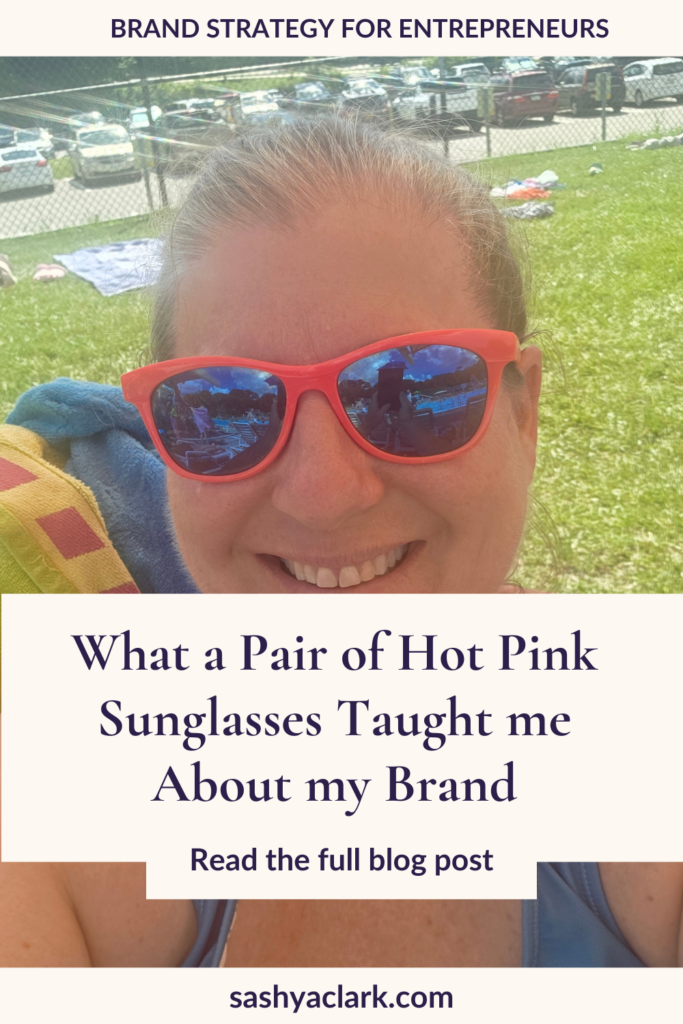
It was the 4th of July, so the pool was packed: moms, dads, more kids than I could count, every umbrella taken. We found one open spot in the shade, waaaaaay at the back, just enough room for all four of us to set our things down. As the swim bag that’s stayed packed and ready to go all summer came to it’s resting place, I saw them poking out of the pocket to remind me: My hot pink “wink back to the 80’s” cheap sunglasses, and I realized I was still wearing my driving pair by mistake. I must have said something out loud, because one of the other moms gave me a look like, who cares? I smiled, swapped them out for my hot pink ones and we headed for the water.
I don’t really swim. My kids swim. I dip my feet in, cool off when I get too hot, and mostly sit at the edge sunbathing like a Leo, watching my cubs from the shade the way a lioness would on the savanna. Long hair. I don’t love getting it wet.
A few chairs down, another mom kept calling her family’s names, trying to wave them out of the pool. They could hear her. But they kept looking around. They just couldn’t spot her in the crowd.
That’s the exact thing I discovered years ago, back when my kids were all still under ten. Wearing the same pair of hot pink sunglasses to the pool every single day was strategy, not vanity, long before I had a word for it.
Why I Almost Didn’t Wear Them
At first I hesitated. When you’ve got three boys heading into their teenage years, you don’t necessarily want to be the family everyone clocks the second you walk in. Some part of me wanted to blend in a little. But I kept wearing the same cover-up and the same glasses to the pool anyway, mostly because they’re my favorite color and I never got around to replacing them.
The Day It Actually Mattered
One summer, my youngest, about five at the time, wandered from the kids’ area into the big pool without telling anyone. He was already a strong swimmer. He wasn’t in danger. But I looked up and he wasn’t in front of me anymore, and for a few very long seconds, I panicked.
He found me before I found him. Because of the glasses.
He came straight over and asked if I was okay. I told him I’d been scared because I didn’t know where he’d gone. He said he thought he’d told me; he probably had, and I just hadn’t heard him over a conversation with another mom. He’d done everything right. I just hadn’t caught it.
I didn’t have to convince him to come find me. He saw me. He clocked that I looked worried and came straight over, no explanation needed first. That’s what a real brand does. It skips the convincing (which in marketing is good news, because convincing feels so wrong, sometimes).
A Brand Is a Signal, As Much as a Style
A brand is the set of values and signals that make you recognizable, not just your fonts or your color palette.
If you do Human Design readings, your brand is what makes you different from every other reader doing the same overlay. If you’re a life coach, it’s what separates you from every other life coach with the same certification. A clear brand signals to the right people, the ones already looking for exactly what you offer, that you’re the one worth a second look.
Why an In-Demand Brand Skips the Convincing
When your signal is consistent, you stop having to talk people into choosing you. Your person recognizes you the way my son recognized a pair of hot pink glasses in a crowd of a hundred strangers. That recognition is your brand advantage, and it’s available to you whether you’re just starting out or five years into a business that still doesn’t quite feel like yours yet.
Out of billions of people on this planet, there’s a specific group already looking for exactly what you do: the people on your fractal line. Once your signal is clear, they find you. You don’t have to convince them, and that whole map already exists. It’s sitting in your chart.
Most people haven’t found their fractal line yet because they haven’t looked through the right glasses to see it. LOL.
You don’t need a bigger, louder presence. You need one signal, repeated consistently, until your people can’t miss you even in a crowd.
If you’re not sure yet what your own signal looks like, the Brand Archetype Quiz is a good, free place to start, and it’s built from your actual chart, not a guessing game. You don’t have to figure out your brand from scratch any more than I had to figure out which sunglasses to grab for a crowded pool. You’re already doing it. We just need to make it intentional.
No rush. Whenever you’re ready.
I know exactly how much my hot pink glasses matter now. They live in that swim bag permanently. I never leave home without them.
(((HUGS))), Sashya
Frequently Asked Questions about Branding
What does it mean when someone says a business needs an “in-demand brand”?
An in-demand brand means the right people recognize and trust you before you have to explain yourself. It comes from consistent signals: how you show up, what you say, and what you’re known for, repeated often enough that people spot you in a crowded market. It’s about being recognizable, not the loudest option in the room.
Is branding really more than just my logo and color palette?
Yes. Fonts and colors are part of a visual identity, but a brand is the full pattern of signals that make you recognizable and trustworthy: your values, your voice, your consistency, and what you’re known for solving. A polished visual identity without a clear signal underneath it can still leave you invisible to the people you’re trying to reach.
How do I make sure my ideal clients can actually find me?
Show up the same way, consistently, long enough for a pattern to form. That might be a signature phrase, a specific tone, a recurring topic, or something as simple as a pair of hot pink sunglasses. Consistency is what turns “I’ve seen that somewhere” into “that’s exactly who I need.”
What’s the difference between visibility and a brand advantage?
Visibility means people see you once. A brand advantage means people recognize you the moment they see you again, and trust builds because of it. You can be visible and still forgettable. A brand advantage means you’re the one they remember when they’re ready to buy.
Do I need a fully figured-out brand before I can start attracting the right clients?
No. Most people build their signal gradually, the way I kept wearing the same sunglasses to the pool for years before I understood why it worked. Start with one consistent thing you repeat on purpose, and let it sharpen over time as you learn what your people actually respond to.
What does it mean to be on someone’s “fractal line”?
In Human Design, your fractal line is the specific group of people your energy is built to attract and serve, the ones already looking for exactly what you offer, out of the billions of people on this planet. You don’t chase them. Once your signal is aligned, they recognize you the way my son recognized my hot pink glasses at a crowded pool. The specifics of who’s actually on your line, and why, live in your chart. That’s exactly what we map in a Business by Design Strategy Session ℠.
About Sashya Clark

Sashya Clark is the founder of CaTellyst Coaching, the author of the Human Design and Gene Keys Gates Library, and the creator of the Business by Design Strategy Session ℠, a proprietary method that derives personal brand archetypes + business strategy directly from your Human Design and astrology charts. She has built five businesses over 20 years and now helps spiritual entrepreneurs build brands that feel like them, attract the right clients, and convert without the burnout. She’s also currently writing a book about her own journey letting go of childhood conditioning to become a more authentic expression of herself.
Be the first to find out when it’s published.