The Human Design Solar Plexus
Learning to Ride the Waves of the Emotional Solar Plexus with compassion
Good morning, and welcome back to Human Design for Parents and Kids. I’m Sashya, your host.
I’ve been fairly radio silent for the last month, largely in mourning. Like many of you, I’ve been holding the weight of the collective—grieving, processing, and doing what I do best as a 6/2 Mental Projector: stepping back, observing, and integrating before speaking.
Today, I’m emerging from my hermit cave to talk about something that feels especially relevant right now: how to ride the emotional waves of the Solar Plexus Center.
Before we go any further, I want to name something important:
I have a completely open Solar Plexus. No gates. No definition.
And while that means this center has been one of my greatest sources of conditioning and deconditioning, it has also been one of my greatest teachers—especially during twelve years working in a counseling role, where I learned to hold emotional space without becoming emotionally overwhelmed.
What the Solar Plexus Center Really Is
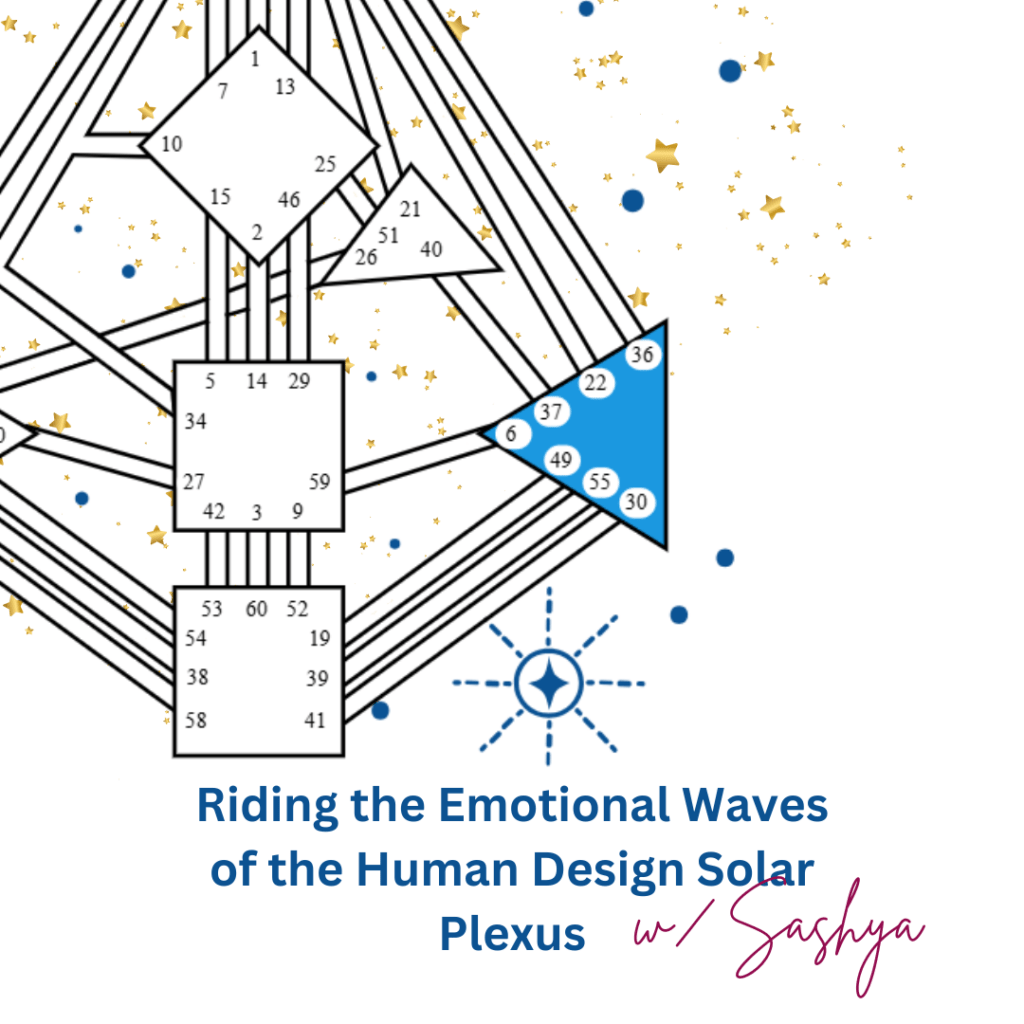
The Solar Plexus Center is the center of emotions, emotional waves, and emotional truth over time. About 50% of the population has a defined Solar Plexus, meaning they generate emotional waves that ripple into families, workplaces, and communities.
The other 50%—those with undefined or open Solar Plexuses—learn how to sail those waves.
And make no mistake:
Emotions are not a problem.
Emotions are energy in motion.
They move in waves.
They are not “the truth,” but they feel very true while they’re happening.
The Body–Emotion Connection (Especially for Kids)
The Solar Plexus is deeply connected to:
- The Sacral
- The Root
- The Spleen
Which means emotional waves are often intensified by:
- Exhaustion
- Hunger
- Dehydration
- Loneliness
- Stress
- Feeling disempowered
Before trying to “fix” a feeling—especially in a child—always check the basics:
Are they tired?
Are they hungry?
Are they overwhelmed or powerless?
Very often, emotional waves are the body asking for care.
The Emotional Waves of the Solar Plexus
Let’s talk about the three main emotional wave patterns, using the ocean as our metaphor.
🌊 The Source Wave — Channel 59–6
(Intimacy, Bonding, Friction)
This wave moves like the tides—predictable, relational, rhythmic.
It governs:
- Emotional closeness
- Sexuality
- Interpersonal friction
Tension here isn’t inherently bad. In healthy relationships, it can feel like longing or creative friction rather than conflict.
Children with this wave need:
- Safe emotional connection
- Permission to move toward and away
- Reassurance during emotional highs and lows
🌊 The Individual Waves — Channels 22–12 and 39–55
These waves are rapid, intense, and deeply personal.
Channel 22–12 (Openness)
This channel connects emotion directly to expression.
Children (and adults) with this channel often need:
- Space to talk through feelings
- Time to express without interruption
- Reassurance that they belong, even when they feel different
Channel 39–55 (Spirit & Provocation)
This wave seeks feeling alive.
It may provoke emotional reactions in others—not to cause harm, but to create resonance.
For open Solar Plexus parents (like me), this can feel overwhelming unless we learn to regulate our exposure.
Turning the “volume down” is not coldness.
It’s self-regulation.
Music is a powerful ally for these waves:
- Blues or jazz for melancholy
- 80s pop for uplift
- High-energy music for motivation
Curated playlists can help children move emotions instead of getting stuck in them.
🌊 The Collective Waves — Channels 36–35 and 37–40
These waves are about experience, community, and emotional storytelling.
They move in larger arcs and often involve:
- Anticipation
- Crisis
- Meaning-making after emotional experiences
These waves benefit greatly from reflection after the emotion has passed.
Being the Shore, Not the Wave
When a child (or partner) is in a big emotional wave, our job isn’t to drown with them.
It’s to be the shore.
Steady. Present. Non-reactive.
I often visualize myself as the sand beneath the waves—allowing emotions to crash, recede, and move without judgment.
That steadiness teaches emotional safety more than any words ever could.
Human Design Gates of the Solar Plexus Center
(Perfect for hyperlinking individual Gate posts)
- Gate 6 – Friction & Emotional Boundaries
- Gate 12 – Caution & Emotional Expression
- Gate 22 – Grace & Openness
- Gate 30 – Desire & Emotional Intensity
- Gate 36 – Crisis & Growth Through Experience
- Gate 37 – Family, Community & Emotional Agreements
- Gate 49 – Principles & Emotional Revolution
- Gate 55 – Spirit, Mood & Emotional Depth
If you’re noticing how much emotional energy you’ve been holding—yours or others’—Designed to Be Loved offers a gentle way to come back to yourself.
It’s a reparenting and deconditioning guide rooted in Human Design, created to support emotional safety, regulation, and self-trust.
If you’re ready to stop guessing and start understanding your child with clarity and confidence,
the self-paced course Understanding Your Child’s Human Design will teach you how to read your child’s chart and respond to their energy in ways that actually support who they are.
This course is designed for parents who want practical insight, less emotional friction, and tools they can use immediately—one child, one chart, one step at a time.