Human Design Head Center for Entrepreneurs
The Human Design Head Center: Why Your Best Ideas Feel Like Pressure, Not a Plan
What Is the Human Design Head Center?
The Head Center is the pressure center at the very top of the Human Design bodygraph, where inspiration and mental pressure enter the system. It doesn’t think, analyze, or process anything itself: it only generates the pressure to question, wonder, and seek understanding. A share of the population carries it defined, generating a personal and consistent stream of original ideas; most people carry it undefined or open, picking up and amplifying the mental pressure of whoever is around them. For entrepreneurs, this center is where new offers, questions, and half-formed ideas first show up, well before any of them are ready to become a plan.
You have more ideas this week than you had time to write down. A new offer. A course you could teach in your sleep. A question you cannot stop turning over. None of them are finished, and all of them are loud.
Somewhere along the way, most entrepreneurs learn to treat that as a productivity problem: too many ideas, not enough follow-through. It is not. It is your Head Center, doing exactly the job it was built to do.
The Head Center is not asking you to have an action plan today. It is asking you to trust that the pressure itself is information, and information is not the same thing as an instruction to act right now.
So… What Is the Head Center?
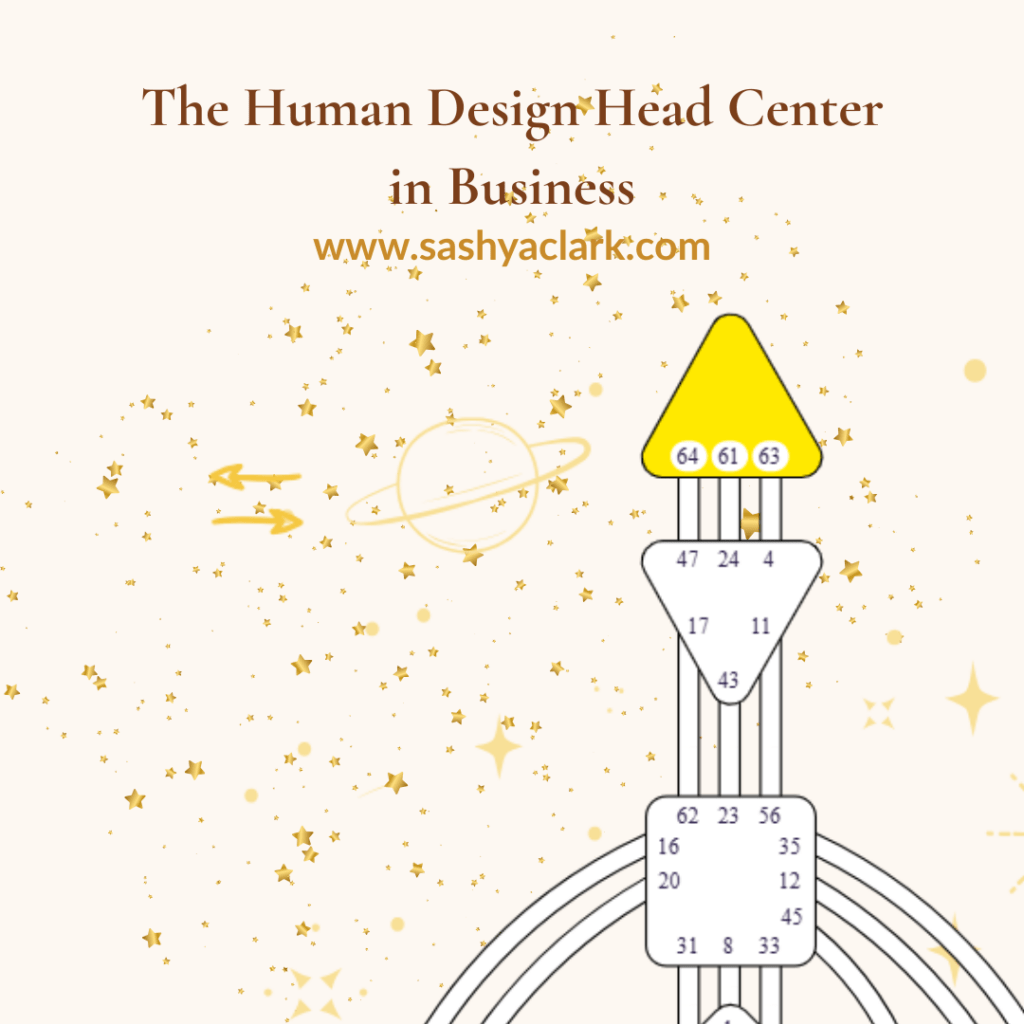
The Head Center is the very top triangle of the Human Design bodygraph, sitting above the Ajna. It is a pressure center, not an awareness center: it does not think, analyze, or form opinions. It just generates the pressure to question, to wonder, to seek.
Here is what it is NOT: a source of answers. The Head Center’s entire job is to push inspiration down into the Ajna, where it can be processed into a thought. On its own, the Head Center just presses. It presses until you pay attention.
For a lot of entrepreneurs, that pressure gets mistaken for urgency. It is not urgency. It is an invitation to stay curious a little longer than feels comfortable.
When it is flowing, that pressure feels like a low, steady hum: ideas surfacing, questions forming, nothing demanding to be solved this second. When it gets stuck, the same pressure turns into static, and static is what pushes people to force an answer before one is ready.
Defined or Undefined: Two Very Different Relationships to Inspiration
A meaningful share of entrepreneurs carry a defined Head Center. Most people carry it undefined or fully open. The difference shapes where your best business ideas come from, and what you are best suited for when you show up in a room.
If your Head Center is defined: you generate a consistent, personal stream of inspiration. Your questions come from inside you, on a rhythm nobody else can quite replicate. This is a real asset in business: you can build original frameworks, teach from your own synthesis, and keep producing fresh content and offers long after other people would have run dry.
Think of it like a spring that never fully dries up. Even on a slow week, there is another idea sitting a few feet under the surface. The skill is not generating more of them. It is trusting which ones are ready to dig out.
The trap for a defined Head Center is treating every pressure-filled idea as urgent. Gate 64 lives here, and its whole teaching is that confusion is allowed to sit before it resolves. Rushing an idea into the world before it has finished forming is how a good idea gets launched half-baked.
If your Head Center is undefined or open: you do not generate a consistent stream of your own inspiration. Instead, you pick up and amplify the mental pressure of whoever is in the room: the client call, the industry, the moment. This is where the business application gets interesting, and where the standard teaching tends to sell this configuration short.
An undefined Head Center is not a lesser version of a defined one. It is a different skill entirely.
You are built to sense what questions are already circulating before anyone has said them out loud. That makes you unusually good at naming what a room, a market, or an audience is already asking, before your competitors have found the words for it. Call it thought leadership from a different angle: the question was already in the room, and you were the one who said it first.
Picture five different clients hinting at the same fear across five separate calls, none of them saying it outright. An undefined Head Center is the one who finally says the quiet part out loud in a caption or a workshop, and the room exhales because someone finally named it. That is not luck. That is the center doing its job.
The work is learning to tell the difference between the room’s mental pressure and your own. When you cannot tell them apart, someone else’s confusion becomes your 2am spiral. When you can, that same sensitivity becomes the thing that lets you walk into a room, feel what everyone is already asking, and set the direction before anyone else names it.
The Thing Nobody Is Teaching Clearly Enough
There is a piece of advice that circulates constantly around inspiration in business: capture the idea, then build the plan immediately, while the momentum is hot.
I understand the instinct. Momentum feels productive, and sitting with an unfinished idea feels like falling behind.
But the Head Center was never built to hand you a plan. It was built to open a channel, and the plan is not its job. When you force a fresh piece of inspiration straight into a to-do list, you skip the part where the idea finishes forming, and you end up building on something that was never fully baked in the first place.
This shows up constantly with a defined Head Center: the pressure to have the whole strategy figured out the moment the idea arrives. It shows up just as often with an undefined Head Center: absorbing the market’s collective urgency and mistaking it for a personal deadline.
Either way, the fix is the same. Let the pressure sit. Write it down. Trust that your Strategy and Authority, not your Head Center, is what tells you when to move.
Human Design Gates of the Head Center
Gate 64: Confusion carries the pressure of too many questions and half-formed ideas arriving at once. In business, this is the entrepreneur with eleven ideas by Tuesday and no idea which one to build first. Gate 64 pairs with Gate 47 in the Ajna Center to form the Channel of Abstraction, turning raw confusion into eventual understanding. The gift is not solving the confusion faster. It is trusting that clarity forms on its own timeline.
Gate 61: Mystery carries the flash of inner truth that arrives without a logical explanation attached. In business, this is the idea or conviction you cannot fully explain but know is right: the thing that becomes real thought leadership once you trust it enough to say out loud.
Gate 63: Doubt carries the pressure to question patterns, especially the ones that already worked once. In business, this is the instinct that keeps you testing instead of coasting on last quarter’s win, and the reason you notice when something that used to work has stopped working before anyone else does.
What This Means for Your Business
Your Head Center is not a productivity system, and it was never meant to be one. Whether it is defined or undefined, its entire job is pressure, not plans.
A defined Head Center gives you a personal, renewable source of original ideas. Respect the pace they need to form. An undefined Head Center gives you the ability to sense what a room or a market is already asking, before it has been named anywhere else. Respect that the pressure you are feeling might not even be yours.
Either way, the business move is the same: let the questions sit long enough to become real clarity, instead of rushing them into a plan they were never built to carry.
Want to See How Your Head Center Is Showing Up in Your Brand?
If you have ever walked out of a launch with ten new ideas and zero clarity on which one to build, your Head Center was probably part of that story. That pressure was never a flaw. It was doing exactly its job.
If you are curious how your specific Head Center, defined or undefined, is showing up in your brand and your business decisions, the Business by Design Strategy Session℠ is built to show you that.
And if you are just curious which brand archetype is already coded into your chart, the Brand Archetype Quiz is where that answer lives. Birth data in, your archetype out. No ten questions. No mood-dependent answers. Just what is already true about you.
Sashya Clark is the founder of CaTellyst Coaching, the author of the Human Design and Gene Keys Gates Library, and the creator of the Business by Design Strategy Session℠, a proprietary method that derives personal brand archetypes and business strategy directly from your Human Design and astrology charts. She has built five businesses over 20 years and now helps spiritual entrepreneurs build brands that feel like them, attract the right clients, and convert without the burnout. Learn more at sashyaclark.com.
(((HUGS))) — Sashya
Frequently Asked Questions about the Human Design Head Center
What is the Head Center in Human Design?
The Head Center is the pressure center at the top of the Human Design bodygraph, responsible for inspiration and mental stimulation. It sits above the Ajna Center and does not process or analyze anything itself: it only generates the pressure to question and seek understanding. Most people carry it undefined or fully open, picking up and amplifying inspiration from whoever is around them, while a smaller share carry it defined, generating a consistent personal stream of original ideas. For entrepreneurs, the Head Center is where new offers, questions, and half-formed ideas first arrive, well before they are ready to become a plan.
Where is the Head Center located, and what gates does it contain?
The Head Center sits at the very top of the bodygraph, directly above the Ajna Center, and contains three gates: 64, 61, and 63. Gate 64 (Confusion) carries the pressure of too many ideas arriving at once. Gate 61 (Mystery) carries flashes of inner truth that arrive without a logical explanation. Gate 63 (Doubt) carries the pressure to question patterns, especially ones that already worked once. None of these gates connect directly to the Throat, so the Head Center’s entire job is pressure and inspiration, not action or communication.
What does it mean to have a defined Head Center in business?
A defined Head Center gives an entrepreneur a consistent, personal source of original inspiration. Ideas arrive on their own internal rhythm, which makes it possible to build original frameworks, teach from personal synthesis, and keep generating fresh content and offers over time. The common challenge is treating every pressure-filled idea as urgent enough to act on immediately. Gate 64’s teaching, that confusion is allowed to sit before it resolves, is especially relevant here: rushing an idea into the world before it has finished forming is how a good idea gets launched half-baked.
What does it mean to have an undefined or open Head Center in business?
An undefined or open Head Center picks up and amplifies the mental pressure of whoever is in the room, rather than generating a personal, consistent stream of inspiration. This is not a lesser version of a defined Head Center: it is a different skill, built to sense what questions are already circulating in a market or industry before anyone has named them. That sensitivity can become real thought leadership once the entrepreneur learns to tell the room’s mental pressure apart from her own, instead of absorbing it as personal confusion or overwhelm.
Is it better to have a defined or undefined Head Center?
Neither configuration is better: they serve different business functions. A defined Head Center is built for generating original ideas and frameworks on a personal, renewable rhythm. An undefined or open Head Center is built for sensing and naming what a market or room already needs to hear, functioning as an amplifier and thought leader rather than an originator. The business move is the same either way: let the mental pressure sit long enough to become real clarity, instead of rushing it into a plan before it is ready.
About Sashya Clark

Sashya Clark is the founder of CaTellyst Coaching, the author of the Human Design and Gene Keys Gates Library, and the creator of the Business by Design Strategy Session ℠, a proprietary method that derives personal brand archetypes + business strategy directly from your Human Design and astrology charts. She has built five businesses over 20 years and now helps spiritual entrepreneurs build brands that feel like them, attract the right clients, and convert without the burnout. She’s also currently writing a book about her own journey letting go of childhood conditioning to become a more authentic expression of herself.
Be the first to find out when it’s published.